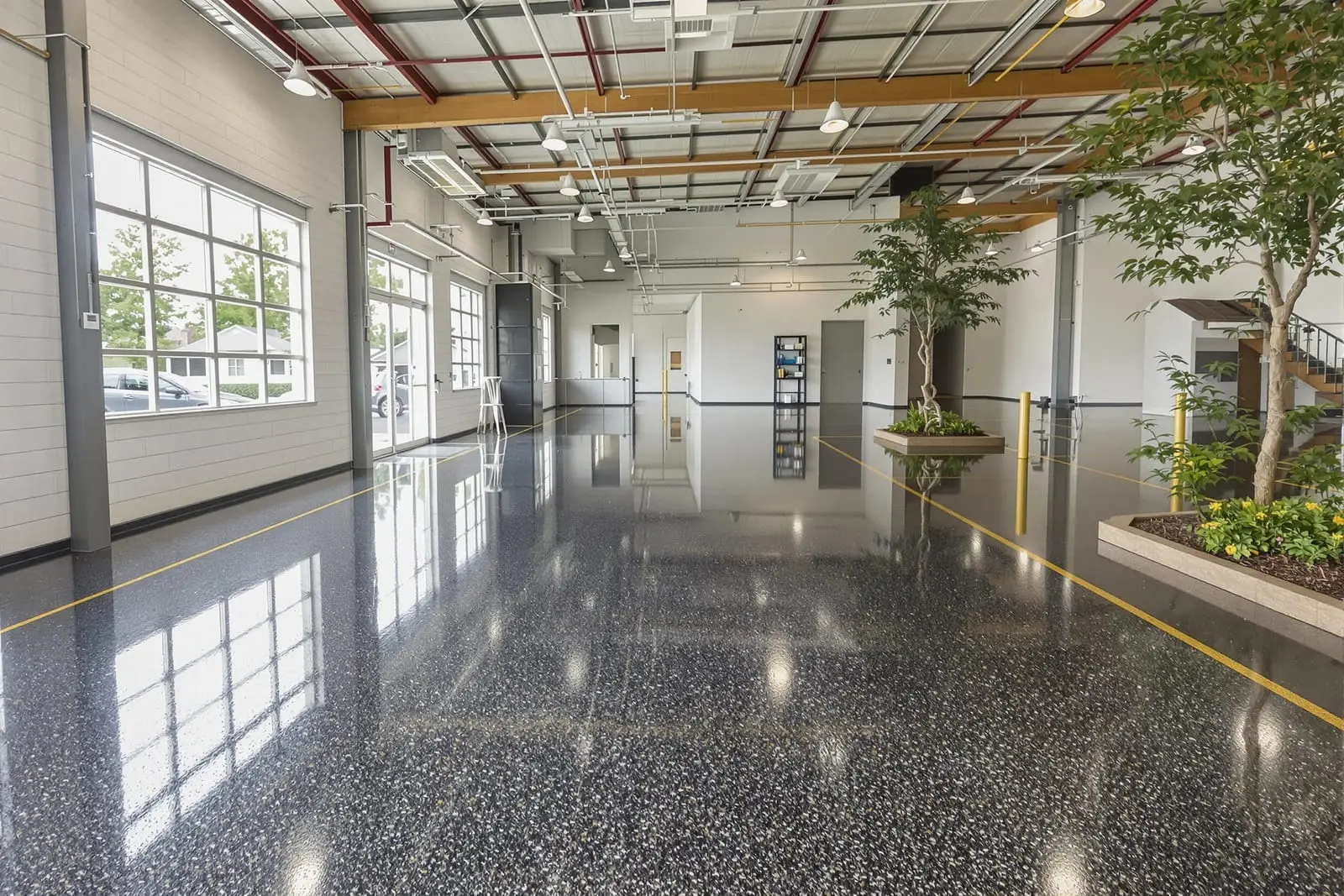
We install warehouse and industrial concrete floors in Nashville, TN that handle forklifts, racks, and heavy machinery. Our slabs are designed for flatness, load capacity, and durability. We offer options for hardened surfaces and joint detailing to reduce maintenance. Get a floor that supports efficient operations for years.
Primetime Concrete Nashville provides professional industrial concrete floors throughout Nashville, TN and the surrounding area. Our licensed, insured crew delivers safe, clean, on-time work with a free estimate before anything begins. Call (629) 317-4022 or request your free quote.
Industrial concrete floors built for Nashville warehouses
Warehouse and industrial concrete floors in Nashville take more abuse than any other surface in a building. Forklifts, pallet jacks, chemical spills, hot summers, cold snaps, and constant traffic all show up in the slab if it is not designed and installed correctly. Primetime Concrete Nashville focuses on the specific loads, equipment, and workflow in your facility so the floor actually fits how you use the space, not a generic warehouse template.
We start with a site visit. We look at existing slabs, subgrade conditions, drainage around the building, and what kind of racking, machinery, and traffic you have or plan to add. In Middle Tennessee, soil can switch from hard clay to fill in a single property, and that matters for slab thickness and reinforcement. We also factor in local freeze-thaw cycles and humidity, which affect curing, joint spacing, and long-term curling.
From there, we recommend slab thickness, concrete mix, reinforcement style, and joint layout that match your operations. A light manufacturing shop in the Nations needs something different than a heavy distribution center near I-24 with constant semi loading. Our goal is to avoid the problems you usually see in older Nashville warehouses: broken joints, rocking racks, standing water, and constant dusting on the surface.
How we design warehouse and industrial concrete floors
Industrial concrete floors are not just poured thicker. The design is driven by numbers: wheel loads from forklifts, rack post loads, slab size, and the strength of the soil underneath. Primetime Concrete Nashville works with these inputs so your floor is engineered for your real use instead of a rough guess.
We often recommend 6 to 8 inch slabs for typical warehouse work, thicker if you have very heavy point loads or machinery. We design reinforcement based on risk tolerance and budget. Options include traditional rebar grids, welded wire mesh, or steel fibers distributed through the mix. Fiber-reinforced floors can reduce the amount of conventional steel, which speeds installation and helps control cracking, especially in large, open bays.
Concrete mix design matters as much as thickness. For industrial floors, we usually specify higher compressive strength concrete (4,000 psi or more), lower water content for durability, and admixtures for shrinkage control and workability. In Nashville summers, we often add set-control admixtures so the crew has enough time to place and finish the slab before it starts to tighten up in the heat. In cooler months, we may use accelerators and protect the slab from freezing during cure.
Joint planning is another key piece. We lay out control joints based on slab thickness and bay spacing so random cracks are guided into straight lines that can be sealed. For facilities using hard wheels or automated guided vehicles, we consider doweled joints or armored joint systems so wheels roll smoothly without chipping edges. The layout is coordinated with your racking and doorway locations so joints do not fall under rack posts or high-impact areas.
Installation process that fits Nashville weather and warehouse schedules
Once the design is set, Primetime Concrete Nashville builds a clear schedule around your operations. For existing facilities, we often pour in phases so part of the warehouse stays functional. We also pay attention to local weather patterns, since Nashville humidity, heat, and thunderstorms directly affect industrial concrete floors.
We start by preparing the subgrade and base. That means stripping unsuitable material, compacting to proper density, and installing a crushed stone base that drains well. Poor base work is the main reason slabs settle and crack prematurely, especially in older industrial parks where fill dirt was rushed. Where moisture vapor is a concern, especially for buildings that will later receive epoxy or other coatings, we install vapor barriers under the slab.
Formwork and edge details come next, with special attention to dock doors, entrances, drains, and machine pads. We place reinforcement according to plan, using chairs and supports so steel is in the right position instead of buried at the bottom during the pour. Concrete is then placed using chute, pump, or buggies, depending on access. Our crew levels the slab, uses mechanical screeds for flatness, then power trowels it to the finish you choose.
Curing is where many warehouse floors are compromised. In our climate, rapid moisture loss can cause surface cracking and dusting. We apply curing compounds or use wet-curing methods so the slab develops full strength throughout the depth. We also control temperature and airflow when possible, especially in new buildings that are still open to the elements. Joints are cut at the right time, not too early when the surface can ravel and not too late when random cracks have already formed.
Surface options and finishes for industrial use
The surface of an industrial concrete floor affects safety, maintenance, and how well equipment runs. Primetime Concrete Nashville offers several finish options tailored to your industry, not just a one-size-fits-all trowel job.
For high-traffic warehouse aisles, a hard-troweled finish with a densifier is often a good choice. After the slab cures, we apply a concrete densifier that reacts with the surface to reduce dusting and improve abrasion resistance. This type of floor handles forklifts well and is relatively easy to keep clean. For areas where slip resistance is a priority, like loading docks or washdown zones, we can use a broom or textured finish instead of a slick trowel.
If you plan to install epoxy or urethane coatings later, we adjust our approach so the surface is ready for that system. That usually means controlling moisture with vapor barriers, keeping curing compounds compatible with your coating, and scheduling grind and prep work at the right time. We also install slopes toward trench drains or floor drains where required, common in food processing or facilities with regular washdowns.
We can integrate colored hardeners, striping, or embedded plates and anchors during the pour. For example, machinery pads can be thickened sections of the slab with embedded anchor bolts. That keeps heavy equipment from cracking the surrounding floor and simplifies future upgrades. For companies in and around Nashville that expect to change layouts often, we discuss joint layouts and surface treatments that keep flexibility in mind, such as leaving some areas uncoated initially so new lines and pads can be added without major demo.
Costs, common problems, and what to ask before you hire
The cost of industrial concrete floors in Nashville varies based on thickness, reinforcement, mix design, access, and schedule. Thicker slabs, higher strength mixes, fiber reinforcement, doweled joints, and better surface treatments all add to the price, but they can reduce long-term repair and maintenance costs. Night work, tight downtown sites, or pours that require pumping concrete long distances can also raise costs.
Primetime Concrete Nashville explains where your money is going so you can decide what is worth it for your operation. For a 24/7 distribution center with expensive equipment and heavy traffic, it often makes sense to invest more up front in a better mix and joint system. For a lighter-use warehouse that may be repurposed in a few years, a simpler design might be the smarter choice.
Common problems we see in older Nashville industrial floors include curling at joints that causes trip hazards and rocking forklifts, widespread surface dusting that coats inventory, ponding water that leads to slip risks and coating failures, and cracks telegraphing into epoxy or tile later. Most of these issues trace back to poor design, rushed base prep, or inadequate curing. When we are called in to repair, we assess whether partial replacement, joint stabilization, resurfacing, or full replacement is the most cost-effective option.
Before you hire any contractor for warehouse and industrial concrete floors, ask for details about their slab design approach, not just a per-square-foot price. Ask how they handle subgrade testing and compaction, what joint systems they propose, how they will cure the slab in Nashville heat, and what kind of flatness and levelness tolerances they are targeting. Primetime Concrete Nashville is ready to walk you through these specifics so you know exactly what kind of floor you are investing in.
“
Professional warehouse & industrial concrete floors, done right the first time, quality materials, honest pricing, and results that last.
Primetime Concrete Nashville
Warehouse & Industrial Concrete Floors Across Our Service Area