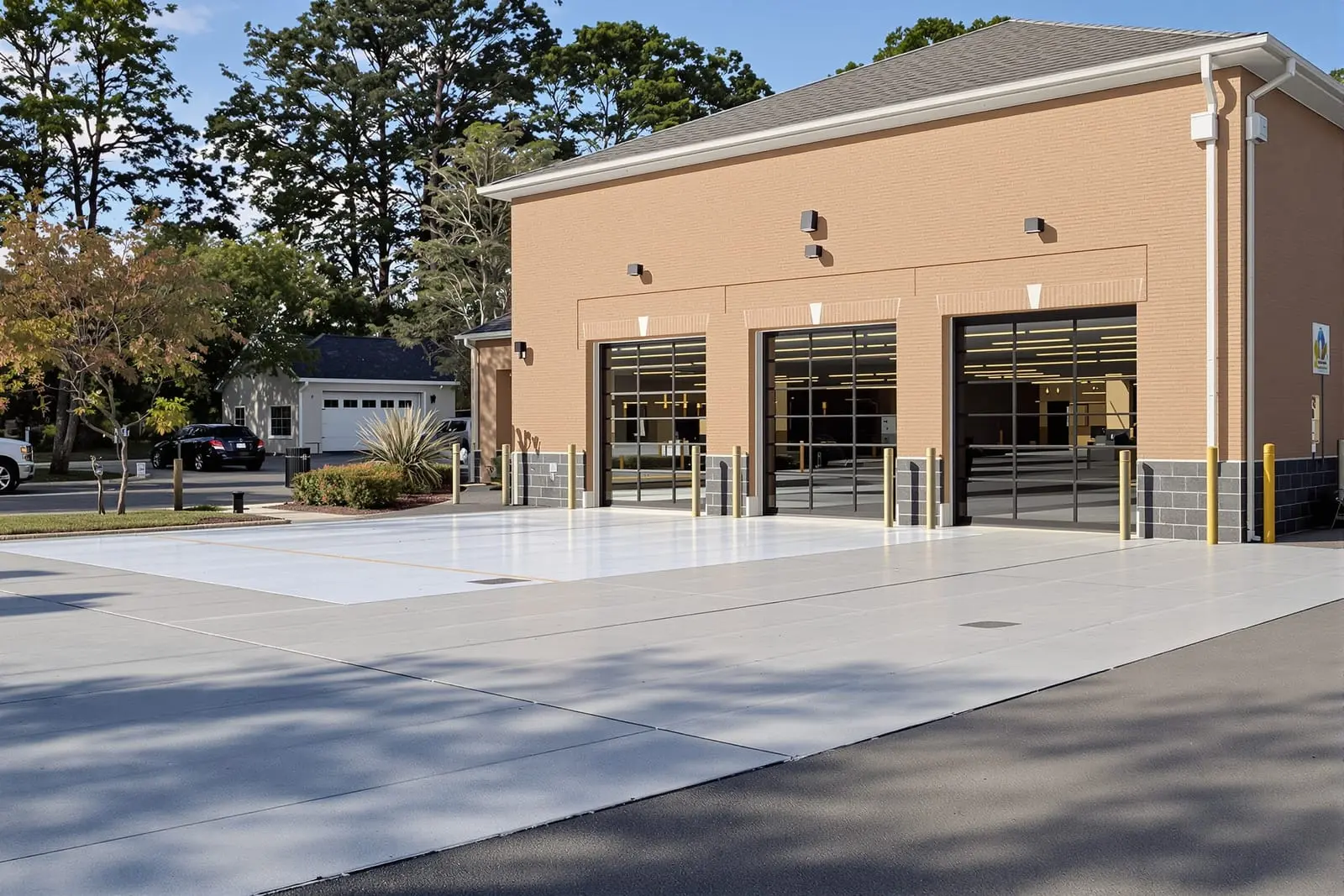
Support deliveries and equipment with properly built commercial concrete slabs in Nashville, TN. We pour loading docks, dumpster pads, and equipment bases that handle impact and point loads. Our commercial concrete contractor team designs thickness, reinforcement, and slopes tailored to your operations.
Primetime Concrete Nashville provides professional commercial concrete slab throughout Nashville, TN and the surrounding area. Our licensed, insured crew delivers safe, clean, on-time work with a free estimate before anything begins. Call (629) 317-4022 or request your free quote.
Loading Docks & Commercial Slabs Built for Nashville Workloads
Primetime Concrete Nashville designs and pours commercial concrete slabs and loading docks that match how your facility actually operates, not just what looks good on a plan. Whether you are unloading freight at a distribution warehouse off I-24, backing box trucks up to a small business near downtown, or supporting heavy racking in an industrial shop, we build slabs and docks for the specific loads and traffic you see every week.
Our team focuses on long term performance in Middle Tennessee conditions. That means planning for hot, humid summers, freeze-thaw cycles in winter, and the kind of sudden storms that can dump inches of rain in a short window. We look at drainage, soil conditions, and expected forklift and truck traffic so your concrete does not start cracking, settling, or spalling a few years in.
You get a local crew that works around your business hours, coordinates with other trades on site, and keeps your operations in mind. We explain your options in plain language, from slab thickness to reinforcement and finishes, before we ever bring a mixer on site.
How We Design a Commercial Concrete Slab That Fits Your Use
Every commercial concrete slab project in Nashville starts with use and loads. Primetime Concrete Nashville gathers details on what will sit on the slab and who will drive over it: pallet racking heights, point loads from machinery, forklift weights, trailer sizes, and expected daily traffic.
Our design steps typically include:
1) Site and soil review. We look at existing subgrade, any signs of poor drainage or soft spots, and whether the soil needs stabilization or additional base rock. In parts of Nashville with clay heavy soils, we often call for thicker compacted stone and sometimes geotextile fabric to separate the base from the soil.
2) Slab thickness and strength selection. For light commercial interiors we may specify a 4 to 5 inch slab at 3,500 to 4,000 psi. For heavy loading docks, truck drive lanes, and trailer staging areas we often move to 6 to 8 inches or more with higher strength mixes. The final spec is based on actual load calculations, not just rules of thumb.
3) Reinforcement planning. We use a mix of options: rebar grids, welded wire mesh, and sometimes fiber reinforced concrete for specific applications. For joints, we plan saw cut control joints in a pattern that fits your floor plan and dock layout to minimize random cracking.
4) Drainage and slope. For exterior slabs and loading docks we plan slopes carefully, often in the 1 to 2 percent range, to move water away from buildings and keep it from freezing at traffic points in winter. In Nashville, where heavy rains are common, undersized drainage is one of the biggest long term problems, so we pay close attention here.
Loading Dock Construction: From Excavation to Finished Dock Face
Loading docks are more than just a thick slab. They are a combination of vertical dock face, approach slab, and dock leveler or ramp integration that has to work smoothly with your trucks. Primetime Concrete Nashville builds docks that match your equipment, trailer heights, and site grades so drivers can hit the dock consistently and safely.
The typical loading dock build process looks like this:
1) Layout and excavation. We set exact elevations based on building finish floor height and truck bed heights, then excavate to allow for base stone and concrete thickness. Poor or uneven subgrade around older buildings in Nashville is common, so we over-excavate soft areas and rebuild with compacted aggregate.
2) Base and formwork. We place and compact crushed stone, usually 6 inches or more for heavy traffic zones, then set forms for the slab and dock wall. For dock faces we install rebar cages and embeds for dock bumpers and leveler pits so steel installers have solid concrete to work with.
3) Reinforcement and accessories. We install rebar, dowels that tie new concrete into existing building slabs or foundations, and any sleeves or conduits needed for electrical or hydraulic dock equipment. For exterior dock aprons exposed to truck turning, we may use heavier bar spacing and stronger mixes.
4) Concrete placement and finishing. We pour the dock wall and slab, consolidate concrete around reinforcement, and finish the surfaces to the texture you need. For truck approaches, we typically use a broom finish for traction in rain. For interior dock areas, a smoother troweled finish or hardened surface can be used if heavy forklifts run there.
5) Curing, joint cutting, and sealing. After finishing, we cure the slab to slow moisture loss and improve strength. We saw cut joints in a pattern that reduces random cracks near dock doors and leveler pits, then seal critical joints and transitions to keep water out and protect edges from chipping.
Commercial Slab Options: Finishes, Reinforcement, and Heavy Duty Upgrades
Different Nashville businesses need different concrete slab features. Primetime Concrete Nashville walks you through specific options instead of a one size fits all slab.
Surface finishes: Exterior loading dock aprons and truck lanes almost always get a broom finish for slip resistance in rain and winter frost. Interior warehouse slabs may get a hard trowel finish for smoother forklift operation, or a densifier and sealer for dust control and easier cleaning.
Reinforcement choices: In high traffic docks and warehouse aisles, we usually prefer rebar over light wire mesh because it stays in place better and performs more reliably under repeated loading. For sensitive floors with high rack loads, we can discuss dowel baskets at joints to control slab movement and protect wheel paths.
Heavy duty options: For facilities with constant forklift traffic, loaded pallet jacks, or very heavy machinery, we can thicken sections of the slab in specific zones instead of overbuilding the entire floor. At dock doors, we often use thicker concrete with closely spaced rebar and armored joint edges to handle the impact and turning of forklift tires.
Protective coatings and sealers: While not always necessary, some commercial slabs benefit from chemical resistant sealers, epoxy coatings, or curing compounds followed by densifiers. We consider what you store and handle, such as food, chemicals, or automotive fluids, before recommending these upgrades.
What Drives Cost for Commercial Concrete Slabs and Loading Docks
Primetime Concrete Nashville prices each project based on real conditions and requirements, not flat per square foot numbers that ignore critical details. Understanding what drives costs helps you compare proposals more fairly.
Key cost factors include:
Slab thickness and concrete strength. Heavier loading and thicker sections use more concrete and more reinforcement. A 6 or 8 inch loading dock apron with rebar and dowels will cost more per square foot than a basic 4 inch light duty pad, but it will also last far longer under trucks.
Subgrade and base prep. Sites with soft or saturated soils, common near low lying areas and older industrial properties in Nashville, need more excavation and more aggregate base. Skimping here is how slabs start to settle and crack within a few seasons.
Access and staging. Tight downtown sites, limited access around existing buildings, or the need to pump concrete over obstacles can add to labor and equipment costs. On the other hand, wide open industrial parks with easy truck access are more efficient.
Reinforcement and details. Rebar quantity, dowel bars, thickened edges, dock leveler pits, and embedded plates all add material and setup time, but they are often necessary for docks and heavy commercial use.
Schedule. If work must be done overnight or on weekends to keep your business running, we can accommodate that, but off hour work can affect pricing. We always lay this out in writing so there are no surprises.
Local Considerations: Nashville Weather, Timing, and Long Term Performance
Nashville’s climate creates specific challenges for commercial concrete slabs and loading docks, and ignoring them leads to issues like surface scaling, joint deterioration, and slab movement. Primetime Concrete Nashville plans work around these realities instead of trying to force a one season schedule.
Summer heat and humidity: During hot months, concrete can set very quickly. We adjust mix designs, use appropriate admixtures, and schedule pours earlier in the morning when needed. This helps reduce plastic shrinkage cracking and allows proper finishing. We also pay special attention to curing so the surface does not dry out too fast.
Winter and freeze thaw: In cooler months, we watch temperature forecasts closely. We avoid placing exterior slabs when freezing is expected before concrete has gained strength, or we use cold weather methods such as insulated blankets and adjusted mixes. Proper air entrainment for exterior slabs helps them withstand freeze thaw cycles around loading areas.
Stormwater and drainage: Sudden storms in Middle Tennessee test every poor drainage design. For loading docks and exterior commercial slabs, we design slopes and integrate drains or swales so water does not sit at dock doors or freeze into sheets of ice. We also consider gutters, downspouts, and runoff from higher terrain so water is directed away from slab edges.
Seasonal scheduling: If your business has slower periods, we can plan slab replacements or new dock construction then to limit disruption. For new builds, we coordinate with your general contractor to fit slab and dock work into the overall schedule without rushing critical steps like curing and joint cutting.
Working With Primetime Concrete Nashville on Your Project
A successful loading dock or commercial concrete slab project comes down to clear planning, honest communication, and proper execution. Primetime Concrete Nashville follows a straightforward process so you know what is happening at every step.
Consultation and site visit: We come to your property, measure, review access, check grades, and talk through how you use the space. This is where we ask about truck sizes, equipment weights, and future expansion plans.
Written proposal and plan: You receive a written scope that details slab thickness, reinforcement type, concrete strength, finishes, and any site work such as excavation or drainage improvements. We explain where we recommend heavy duty details and why.
Scheduling and coordination: We line up material deliveries, equipment, and crew based on your operational needs. For active businesses, we often phase work so part of your dock or yard stays usable while we pour and cure in sections.
Execution and follow up: During the pour and finishing, a lead from Primetime Concrete Nashville is on site to manage crews and answer questions. After the work is completed, we review curing requirements and realistic time frames for driving forklifts or trucks on the new concrete so you protect your investment from day one.
If you are planning a new loading dock, upgrading an older one, or adding a commercial concrete slab anywhere in the Nashville area, we can walk you through options that fit your use, site, and budget without cutting corners that matter.
“
Professional loading docks & commercial slabs, done right the first time, quality materials, honest pricing, and results that last.
Primetime Concrete Nashville
Loading Docks & Commercial Slabs Across Our Service Area